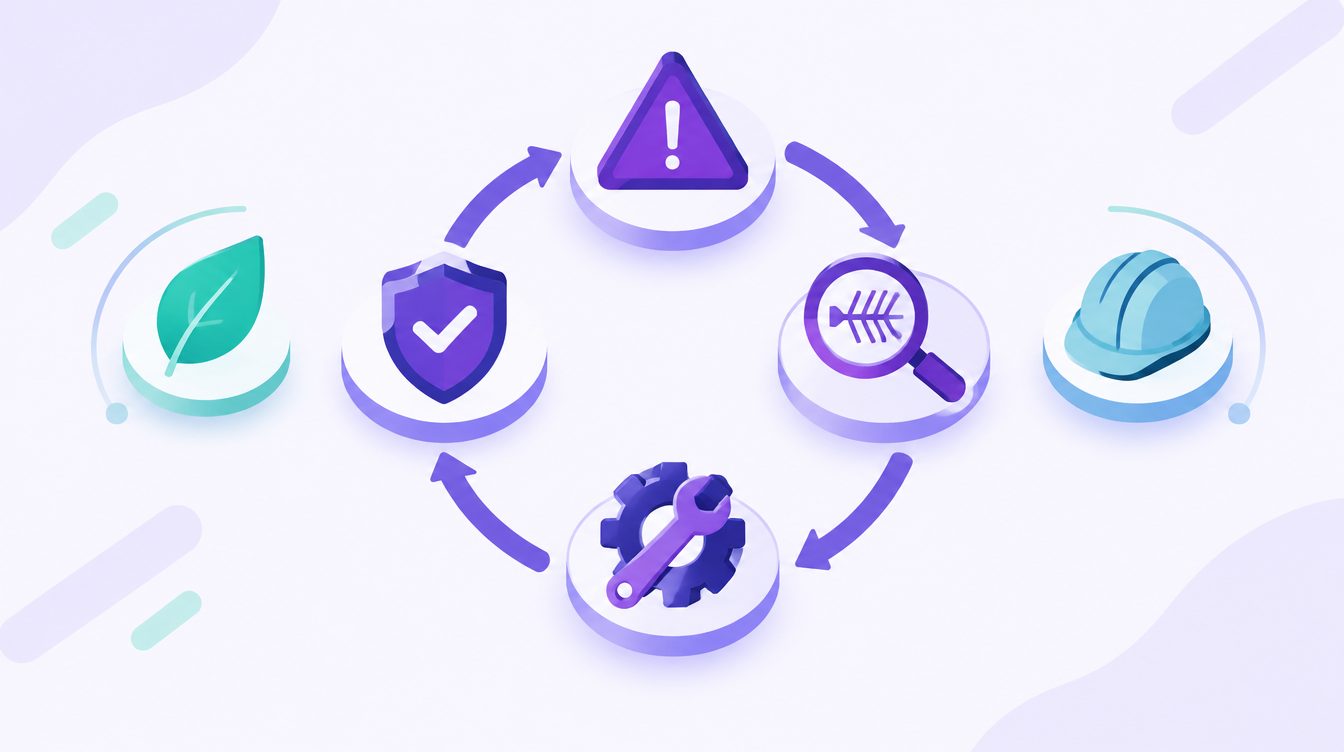
CAPA Management Best Practices for ISO 9001:2026, ISO 14001 and ISO 45001
Corrective and preventive action (CAPA) is where a management system proves it can learn. Whether you run ISO 9001:2026 for quality, ISO 14001:2026 for environment, ISO 45001:2018 for health and safety, or all three as an integrated system, the ability to find causes and stop problems recurring is what auditors test hardest. These CAPA management best practices apply across all three standards.
What the standards require
All three standards share the harmonized management system structure, so the core requirement sits in clause 10.2 in each. You react to the nonconformity, control and correct it, deal with the consequences, evaluate whether action is needed to eliminate the cause, implement it, review its effectiveness and change the management system if needed.
ISO 9001:2026: quality
The focus is product and service conformity and customer satisfaction. Clause 10.2 also requires you to check whether similar nonconformities exist or could occur, and to update the risks and opportunities determined during planning where necessary. Because the 2026 edition separates risks (6.1.2) from opportunities (6.1.3), that update now means reviewing both. Nonconforming outputs themselves are handled under 8.7.
ISO 14001:2026: environment
Triggers include spills, permit exceedances, failure to meet compliance obligations and audit findings. Environmental consequences can be hard to reverse, so containment and dealing with consequences carry extra weight. Our ISO 14001:2026 guide covers what changed in that revision.
ISO 45001:2018: health and safety
Clause 10.2 covers incidents as well as nonconformities, and requires the participation of workers in investigating and deciding actions. Near misses are a valuable input: they are free lessons before someone is hurt.
Best practice 1: one intake for every source
Nonconformities arrive from internal audits, customer complaints, supplier failures, inspections, incidents, near misses and regulatory visits. Capture them in one register with a common set of fields: source, standard affected, severity, owner and due date. Findings raised in ISO audit software should flow straight in rather than being retyped.
Best practice 2: triage by risk
Not every issue needs a full investigation. A typo on a non-critical form may need only a correction. A recurring product defect, a reportable environmental event or a lost-time injury needs the full process. Annex A of ISO 9001:2026 confirms that you decide the extent of investigation based on the risk of recurrence, the impact and customer requirements. Write your triage criteria down so decisions are consistent.
Best practice 3: separate correction from corrective action
- Correction: mop up the spill, quarantine the batch, isolate the guard-less machine.
- Corrective action: install secondary containment, fix the process that produced the bad batch, redesign the guarding.
Record both phases. Auditors look for the second one.
Best practice 4: get to the real root cause
Use a method proportionate to the problem:
- 5 Whys for simple, single-cause problems.
- Fishbone diagrams to explore people, methods, machines, materials, measurement and environment.
- FMEA to rank failure modes before they happen.
Treat "human error" as a symptom. Ask what made the error possible: unclear instructions, poor layout, fatigue, missing error-proofing. ISO 9001:2026 already expects actions to prevent human error in production and service provision (8.5.1 g).
Best practice 5: look sideways
Ask whether the same cause could produce the same problem elsewhere: other lines, other sites, other products from the same supplier. ISO 9001:2026 makes this an explicit step, and it is just as valuable for environmental and safety events.
Best practice 6: define effectiveness before you act
Set the success criterion when you plan the action, not after. Examples: "zero recurrence over the next 1,000 units", "no exceedance in the next six monthly samples", "no repeat near miss on this task for three months". Then schedule the check. A CAPA is not closed because the task is done; it is closed when the evidence shows the problem has gone.
Best practice 7: feed the risk register and the system
Every significant nonconformity is information about a risk you either missed or underrated. Update the risk register, and where the fix changes the management system, plan it as a change: consider its purpose, the integrity of the system, resources, responsibilities, how it will be communicated, and how its effectiveness and results will be reviewed (ISO 9001:2026 clause 6.3).
Best practice 8: control the documents the CAPA changes
Most corrective actions change a procedure, work instruction or form. Route the revision through ISO document control software, link it to the CAPA and notify the people affected, so the fix actually reaches the point of work.
Common pitfalls
- Heavy forms: a ten-page CAPA form discourages reporting. Keep intake light and scale the investigation to the risk.
- Stale CAPAs: actions open for months without progress are an audit red flag.
- "Retrain the operator" as the default: training rarely fixes a system problem on its own.
- Siloed registers: separate quality, environmental and safety logs hide shared causes.
Using CAPA data in management review
Trends in nonconformities and corrective actions are a required management review input in ISO 9001:2026 (9.3.2 d), alongside the effectiveness of actions taken on risks and, separately, on opportunities (9.3.2 g and h). Present trends by cause and by process, not just counts, so top management can decide where to invest.
CAPA management software such as SmartISO keeps intake, investigation, actions, effectiveness checks and document changes in one record across ISO 9001, 14001 and 45001, with reminders and dashboards for management review. See how it fits into wider QHSE software.
Frequently asked questions
What is the difference between corrective and preventive action?
Corrective action removes the cause of a nonconformity that has happened so it does not recur. Preventive action removes the cause of a potential nonconformity before it happens. ISO 9001:2026 makes this distinction in its clause 3 definition of corrective action.
Does ISO 9001:2026 still require preventive action?
There is no standalone preventive action clause. Prevention is built into risk management: you determine, analyse and evaluate risks and plan proportionate actions under 6.1.2, then evaluate whether those actions worked.
How long should a CAPA stay open?
No standard sets a limit, but actions must be timely. Contain immediately, investigate within days or weeks depending on risk, and close only after the effectiveness check is complete.
Can human error be a root cause?
Auditors rarely accept it as the final answer. Keep asking why the error was possible and fix the condition that allowed it.